BRANDON MANITOBA CA
BRANDON MANITOBA
HomeGeophysicsTomografía sísmica de refracción/reflexión

Seismic Tomography in Brandon, Manitoba — Refraction & Reflection Surveys

Rigorous testing. Clear reporting.

LEARN MORE

The National Building Code of Canada (NBCC 2020) sets clear requirements for site classification based on vs30/" data-interlink="1">shear wave velocity, and in Brandon Manitoba the glacial till sequence overlying Cretaceous shale can vary significantly in stiffness and depth. We apply seismic tomography to resolve this vertical and lateral variability with continuous velocity profiles. The method works well here because the contrast between compact till and weathered bedrock is usually sharp enough to produce clear refracted arrivals. When we need additional confirmation of layer geometry we pair the survey with a resistivity survey which helps distinguish saturated sand pockets from clay lenses that might otherwise look similar on travel-time curves.
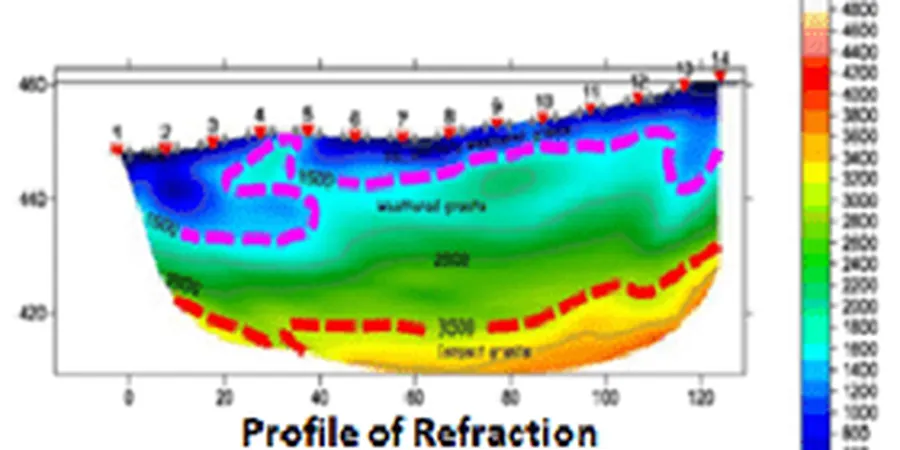
Illustrative image of Tomografia sismica in Brandon Manitoba
In Brandon Manitoba the contrast between compact till and weathered Cretaceous shale produces clear refracted arrivals, but fractured zones require reflection processing to resolve the interface correctly.

Our service areas

Methodology and scope

What we see repeatedly in Brandon Manitoba is that the upper 10 to 15 meters of till can be heavily fractured from glacial loading, while the underlying shale behaves as a low-velocity zone that gets masked in standard refraction processing. Reflection tomography handles that situation better because it images the shale interface directly. We deploy 24 to 48 geophones with a sledgehammer or accelerated weight drop depending on the target depth. For deeper profiles we complement the survey with MASW to capture the 30-meter average shear wave velocity required by NBCC site class definitions. The processing sequence includes first-break picking, travel-time inversion, and ray-trace modeling to produce a 2D velocity section that correlates well with borehole control.
Technical reference — Brandon Manitoba

Local considerations

A commercial development we worked on near the Assiniboine River had a 15-meter fill pad over soft alluvium, and the client assumed the underlying till was uniform. The seismic tomography survey revealed a buried channel filled with loose sand cutting diagonally across the site, exactly where the new foundation was planned. That anomaly would have caused differential settlement in a spread footing system. Because we identified it early the design team switched to driven piles extending into the competent shale. For any site in Brandon Manitoba where previous land use or river proximity introduces uncertainty, seismic tomography is the most cost-effective way to map hidden features before committing to a foundation scheme.

Need a geotechnical assessment?

Reply within 24h.

Email: contact@geotechnicalengineering.xyz

Applicable standards

NBCC 2020 — Site classification based on VS30, ASTM D5777-18 — Standard guide for seismic refraction, ASTM D7128-18 — Standard guide for seismic reflection

Technical parameters

ParameterTypical value
Array length (geophones)24 or 48 channels
Source typeSledgehammer (8 kg) or accelerated weight drop (70 kg)
Geophone frequency4.5 Hz or 10 Hz depending on target depth
Maximum depth investigated30 to 60 meters (refraction); 60 to 120 meters (reflection)
Velocity resolution±5% for first 20 m; ±10% below 30 m
Deliverable format2D velocity section, interpreted layer boundaries, shot gathers
Applicable standardASTM D5777-18 (refraction); ASTM D7128-18 (reflection)

Frequently asked questions

What is the difference between seismic refraction and reflection tomography?

Refraction measures the first energy arrival traveling along layer boundaries and works best when each deeper layer has a higher velocity than the one above. Reflection detects energy reflected from interfaces and can image layers even when a low-velocity zone exists above a higher-velocity unit. In Brandon Manitoba we often use refraction for the upper 30 meters and reflection when we need to see the shale surface below fractured till.

How does seismic tomography compare to borehole drilling for site investigation?

Drilling gives you point information — one borehole tells you exactly what is at that location. Tomography provides a continuous 2D section between shot points, so it reveals lateral changes that a single borehole would miss. We recommend combining both: a few strategically placed holes to calibrate velocities, and tomography to interpolate between them across the site.

What is the typical cost range for a seismic tomography survey in Brandon Manitoba?

For a standard 24-channel refraction survey covering 100 to 200 linear meters, the cost typically ranges between CA$3,980 and CA$6,520. Reflection surveys with 48 channels and deeper processing targets fall at the upper end of that range. Final price depends on line length, source type, and access conditions.

Can seismic tomography be performed in winter or on frozen ground?

Yes, with some adjustments. Frozen ground increases the near-surface velocity significantly, which can mask softer underlying layers in refraction processing. We use heavier sources — typically a 70 kg accelerated weight drop — and we increase the number of shot points to improve resolution. Snow cover does not affect data quality as long as geophone coupling is maintained through the frost layer.

Location and service area

We serve projects across Brandon Manitoba.

Location and service area