BRANDON MANITOBA CA
BRANDON MANITOBA
HomeLaboratoryEnsayo triaxial

Triaxial Testing Services in Brandon Manitoba

Rigorous testing. Clear reporting.

LEARN MORE

We recently received samples from a commercial development along Park Avenue in Brandon Manitoba, where the design team needed reliable effective stress parameters for a deep foundation system. The soils in this part of the Assiniboine River valley tend to be fine-grained lacustrine deposits with moderate plasticity, so a consolidated undrained triaxial test with pore pressure measurement was the right choice. Running the test under CSA + CSA + CSA + CSA + CSA + ASTM D2850 (also CFEM Ch 2) (also CFEM Ch 2) (also CFEM Ch 2) (also CFEM Ch 2) (also CFEM Ch 2) gave the engineers the cohesion and friction angle data they needed. For projects where total stress analysis is sufficient, we also perform unconsolidated undrained tests, but in Brandon Manitoba the saturated clay layers under the water table almost always require effective stress interpretation. Complementing the triaxial work with a corte directo test helps cross-validate residual shear behavior, while the ensayo de consolidación provides settlement parameters that complete the picture for foundation design.
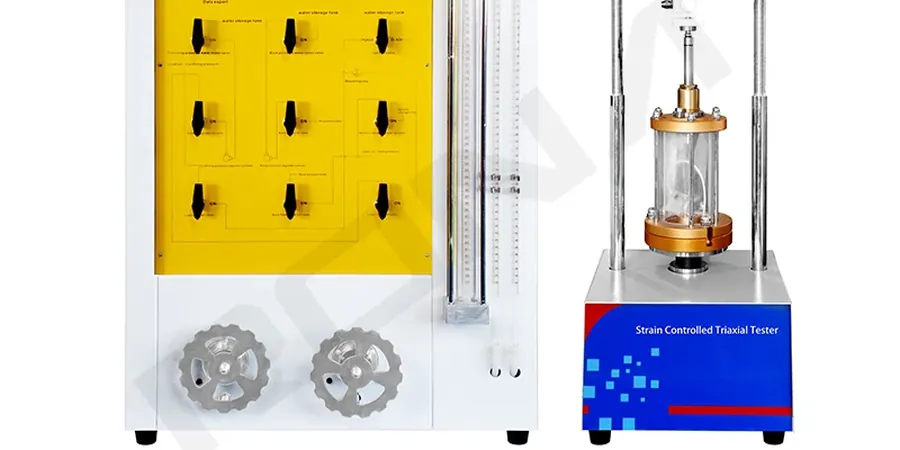
Illustrative image of Ensayo triaxial in Brandon Manitoba
Lacustrine clays in Brandon Manitoba require effective stress triaxial testing; CU tests with pore pressure measurement yield reliable phi and cohesion values for foundation design.

Our service areas

Methodology and scope

Winter conditions in Brandon Manitoba mean that samples can experience freeze-thaw cycles before reaching the lab if not handled correctly, so our sampling protocol follows ASTM D4220 strictly. We trim each specimen to a 2:1 height-to-diameter ratio and saturate it to a B-value of 0.95 or higher before shearing. The consolidation stage applies effective confining pressures that match the in-situ stress range, typically 50, 100, and 200 kPa for shallow foundations. During shearing we strain the sample at 0.5% per minute for CU tests and record pore pressure changes continuously. For projects requiring anisotropic consolidation, such as embankment loading on the soft clay deposits near the Brandon Manitoba industrial park, we run CK0U triaxial tests that better simulate field stress paths. The lab maintains a temperature-controlled environment at 20°C, and the muestreo inalterado procedure is critical to preserve the natural fabric of these sensitive lacustrine clays.
Technical reference — Brandon Manitoba

Local considerations

The lacustrine clay underlying much of Brandon Manitoba has a natural water content near the liquid limit, making it prone to strength loss under undrained loading. A triaxial test that only reports total stress parameters can underestimate the risk of progressive failure in long-term slope stability. We have seen cases where ignoring effective stress analysis led to overestimating the factor of safety by 30% or more. For the glacial till deposits found in the eastern part of the city, the risk is different but still significant: the till contains cobbles that can damage the membrane during shearing, requiring careful specimen preparation and membrane correction. Running a compresión simple test on an adjacent sample helps detect sample disturbance before committing to a full triaxial suite.

Need a geotechnical assessment?

Reply within 24h.

Email: contact@geotechnicalengineering.xyz

Applicable standards

CSA + CSA + CSA + CSA + CSA + ASTM D2850 (also CFEM Ch 2) (also CFEM Ch 2) (also CFEM Ch 2) (also CFEM Ch 2) (also CFEM Ch 2) (CU triaxial), ASTM D4767 (CFEM Ch 4) (CU with pore pressure), ASTM D7181-20 (CD triaxial), ASTM D4220-19 (sample preservation)

Technical parameters

ParameterTypical value
Test typeUU, CU, CD, CK0U
Specimen diameter38 mm, 50 mm, 70 mm
Confining pressure range20 – 1000 kPa
Strain rate0.1 – 2.0 %/min
B-value verification≥ 0.95
StandardsCSA + CSA + CSA + CSA + CSA + ASTM D2850 (also CFEM Ch 2) (also CFEM Ch 2) (also CFEM Ch 2) (also CFEM Ch 2) (also CFEM Ch 2), D4767, D7181

Frequently asked questions

What is the difference between UU and CU triaxial tests?

The UU test does not allow drainage during consolidation or shearing, so it gives total stress parameters (Su). The CU test consolidates the sample under a confining stress before shearing, and pore pressure is measured during shearing, giving effective stress parameters (c', phi'). For Brandon Manitoba lacustrine clays, CU tests are preferred for long-term foundation design.

How long does a triaxial test take?

A UU test takes about 30 minutes per specimen. A CU test with pore pressure measurement takes 2 to 4 days including saturation and consolidation stages. A CD test can take 5 to 10 days depending on the soil permeability. We schedule the triaxial testing based on your project timeline in Brandon Manitoba.

What sample quality is required for a triaxial test?

We require undisturbed tube samples or block samples with minimal disturbance. The sample must show no visible cracks, drying, or remolding. We follow ASTM D4220 for preservation and transport. Samples from Brandon Manitoba clay deposits should be tested within 2 weeks of extraction to avoid desiccation.

Can triaxial testing be used for seismic site response analysis?

Triaxial tests provide static shear strength parameters but not dynamic properties. For seismic analysis, we recommend cyclic triaxial testing or resonant column tests. However, the static CU triaxial parameters are essential input for pseudo-static slope stability and bearing capacity checks under seismic loads per NBCC 2020.

Location and service area

We serve projects across Brandon Manitoba.

Location and service area