BRANDON MANITOBA CA
BRANDON MANITOBA
HomeSlopes & WallsDiseño de estabilización de taludes

Slope Stabilization Design in Brandon Manitoba – Geotechnical Solutions for Safer Slopes

Rigorous testing. Clear reporting.

LEARN MORE

Brandon grew fast after the railway arrived in the 1880s, spreading across the Assiniboine River floodplain and into the rolling prairie. That flat-looking terrain hides a lot of variability: glacial till, lacustrine clay, and random sand lenses left by meltwater channels. We have seen subdivisions where a cut slope stood fine for five years then sloughed after a wet spring. That is why slope stabilization design in Brandon Manitoba has to start with a thorough ground model, not a textbook assumption. Before we run any stability analysis, we always check the soil layering with a georradar GPR survey to map shallow stratigraphy and locate hidden seepage paths.
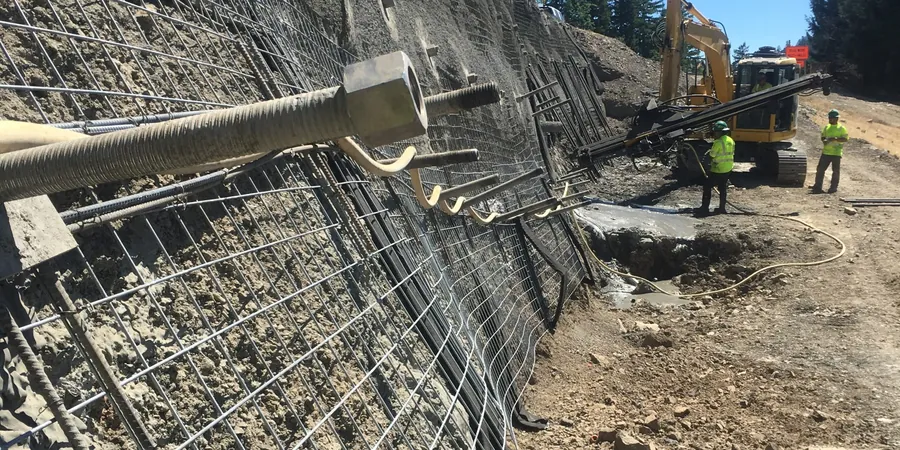
Illustrative image of Estabilizacion taludes in Brandon Manitoba
We calibrate every stability model against local case histories from Brandon Manitoba sites, not generic textbook parameters.

Our service areas

Methodology and scope

For slope stability work in Brandon Manitoba, we bring out the track-mounted drill rig and the portable CPT unit. The drill rig lets us retrieve Shelby tubes of the lacustrine clay that caps many slopes in the city. We run triaxial tests on those samples to get effective stress parameters, because the clay behaves differently under rapid drawdown than under long-term seepage. The equipment list also includes inclinometer casing, vibrating-wire piezometers, and a total station for surface prism monitoring. We install those before any earthwork starts, so we have baseline readings. That data feeds directly into our limit-equilibrium and finite-element models. We follow FHWA-NHI-05 methodology for circular and non-circular failure surfaces, and we calibrate the model against local case histories from Brandon Manitoba sites we have worked on over the years.
Technical reference — Brandon Manitoba

Local considerations

A common mistake we see is contractors cutting a slope to a 2:1 ratio and assuming it will hold because the soil looks stiff. The lacustrine clay in Brandon Manitoba has high undrained strength when dry, but it loses 60 to 70 percent of that strength after a few days of rain. We have investigated a slope failure behind a commercial strip mall where the design never accounted for perched water above a silt seam. That oversight cost the owner CA$80,000 in emergency shoring and legal fees. A proper slope stabilization design in Brandon Manitoba always includes a seepage analysis and a sensitivity check for strength reduction. Skipping that step is a gamble you do not want to take with occupied buildings below the slope.

Need a geotechnical assessment?

Reply within 24h.

Email: contact@geotechnicalengineering.xyz

Explanatory video

Applicable standards

FHWA-NHI-05 (Slope Stability Reference Manual), ASTM D4767 (Consolidated Undrained Triaxial), NBCC 2020 – Section 4.1.8 (Seismic Stability)

Technical parameters

ParameterTypical value
Soil stratigraphy depth range0 – 25 m
Shear strength test typeCU triaxial (ASTM D4767)
Piezometer typeVibrating-wire, 0–200 kPa
Factor of safety target1.3 – 1.5 (static), 1.1 – 1.2 (seismic)
Inclinometer range±30 degrees, 0.01 mm resolution
Seepage modelingSEEP/W or SEEP2D

Frequently asked questions

What are the most common causes of slope failure in Brandon Manitoba?

The main causes are heavy rainfall saturating the lacustrine clay, uncontrolled surface runoff, and undercutting at the toe during construction. We also see failures from poor backfill compaction behind retaining walls. A detailed geotechnical investigation can identify these risks before they become problems.

How much does slope stabilization design typically cost in Brandon Manitoba?

For a typical residential or small commercial site, the cost ranges between CA$2,500 and CA$9,860. This covers site investigation, laboratory testing, stability modeling, and a final design report. Larger or more complex slopes with deep failure surfaces can exceed that range.

What standards do you follow for slope stability analysis?

We follow FHWA-NHI-05 for the slope stability methodology and NBCC 2020 for seismic loads. Soil testing follows ASTM standards such as D4767 for triaxial strength and D4318 for Atterberg limits. We also reference the local Brandon Manitoba building code when it applies to specific projects.

Location and service area

We serve projects across Brandon Manitoba.

Location and service area